M12 X-Coded for 10GbE: The High-Speed Option
The M12 X-coded connector for 10 Gigabit Ethernet: 8-pin shielded pinout, why it beats D-coding for speed, cabling requirements and EtherCAT use.
M12 X-Coded for 10GbE: The High-Speed Option
Quick AnswerOn this page
Quick Answer
The M12 X-coded connector is the high-speed option in the M12 family, supporting Ethernet up to 10 Gigabit. It is an 8-pin connector with its contacts arranged as four shielded pairs, which is what lets it carry far more bandwidth than the 4-pin, 100 Mbit D-coded connector. X-coding is the choice for high-bandwidth industrial networks and demanding protocols such as EtherCAT, and reaching its rated speed depends on using properly shielded, category-rated cable end to end.
What Is an X-Coded M12 Connector?
X-coding exists to bring high-speed Ethernet to the rugged, sealed M12 form factor. While D-coding handles 100 Mbit with two pairs, X-coding uses eight contacts arranged as four pairs, with shielding between the pairs. Those four shielded pairs are what allow Gigabit and 10 Gigabit Ethernet to run over a 12 mm circular connector while keeping crosstalk under control in an electrically noisy plant.
The result is a connector that brings data-centre-class bandwidth out to the machine without giving up M12's IP-rated sealing and threaded locking. As factories converge IT and OT networks and add bandwidth-hungry devices, X-coding has become the standard for the fast end of industrial Ethernet. For where it sits among all the codings, see the M12 connector types guide.
X-coding is also designed to be backward-friendly at the application level: because it carries standard Ethernet, an X-coded link can run Gigabit or fall back to slower Ethernet speeds depending on the devices at each end, while still using the same connector. This makes it a sensible default for new high-performance machines that may mix device generations. The one thing it cannot do is mate with a D-coded port — the keying and pin count differ — so the decision between the two is made per link based on the speed each device needs, not by trying to bridge them with one connector.
The X-Coded Pinout
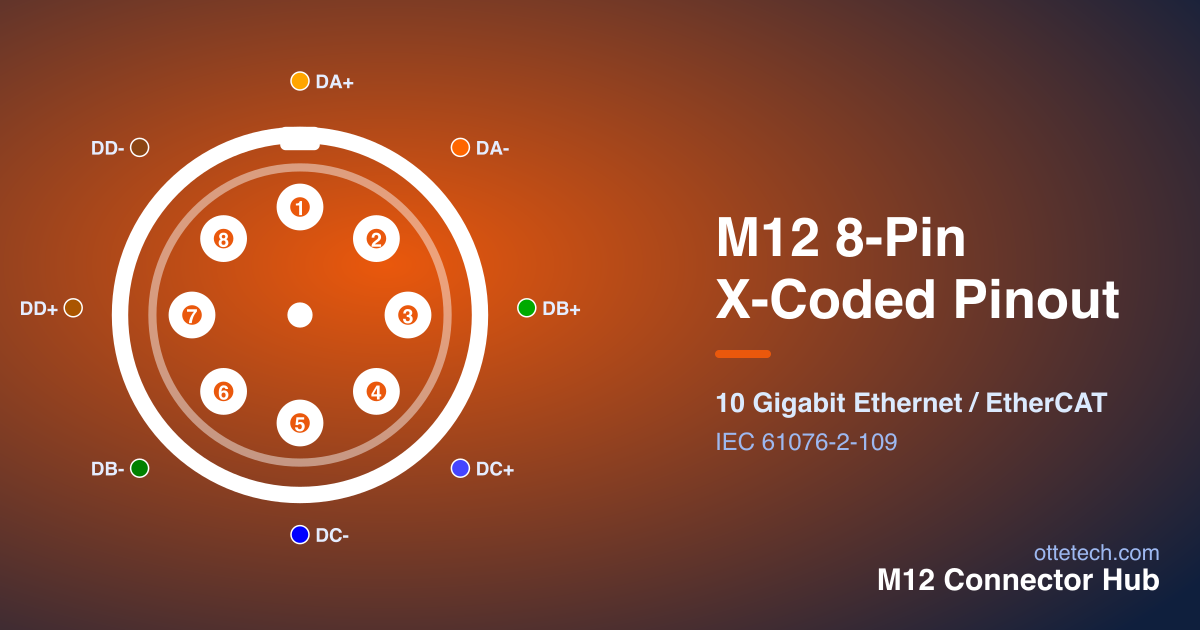
The 8-pin X-coded layout is shown below — four pairs, with shielding between them. Hover a contact to highlight it in the table.
| Pin | Signal | Wire Color | Function |
|---|---|---|---|
| 1 | DA+ | White/Orange | Pair A Data + |
| 2 | DA- | Orange | Pair A Data - |
| 3 | DB+ | White/Green | Pair B Data + |
| 4 | DC+ | White/Blue | Pair C Data + |
| 5 | DC- | Blue | Pair C Data - |
| 6 | DB- | Green | Pair B Data - |
| 7 | DD+ | White/Brown | Pair D Data + |
| 8 | DD- | Brown | Pair D Data - |
The key structural point is that all eight contacts are in use as four pairs, leaving no spare contact for power; like D-coding, X-coding is a data-only interface. Correct pairing and preserving the inter-pair shield right up to the contacts are essential — they are what make the high data rates possible. For how to read the layout, including the male/female mirror, see the M12 connector pinout guide or the interactive Pinout Viewer.
X-Coding vs D-Coding
The choice between X- and D-coding is a choice of speed. D-coding is 4-pin and tops out at 100 Mbit; X-coding is 8-pin and reaches up to 10 Gigabit. If a device or network only needs Fast Ethernet, D-coding is simpler and sufficient — see the D-coded for PROFINET guide. If it needs Gigabit or 10 Gigabit, X-coding is required.
Because the two have different pin counts and keying, they cannot be cross-mated, and you should specify by coding rather than by "M12 Ethernet". When designing a new line that may grow in bandwidth, it is worth choosing X-coding up front if there is any prospect of moving beyond 100 Mbit, since retrofitting connectors and cable later is costly.
Cabling for High Speed
X-coding only delivers its rated speed if the whole link is up to it. The cable must be properly shielded and category-rated for the target speed, and the four-pair shielding must be continuous from end to end. Pairing an X-coded connector with under-specified cable will not produce a Gigabit link — the connector is only one part of the channel.
For this reason, treat the X-coded connector and its cable as a matched assembly rather than independent parts, and keep each pair twisted to the contact during termination. Pre-moulded cordsets from a reputable supplier take the guesswork out of this, since the pairing, shielding and connector are validated together at the factory. If you must terminate in the field, work carefully and verify the link at the rated speed before relying on it, because a marginal high-speed link can pass a basic continuity test yet fail under load. To shortlist X-coded parts by protocol and pin count, browse our 8-pin M12 connectors, use the connector selector, or send your requirements through the inquiry form.
Common X-Coding Mistakes
A few errors come up repeatedly with X-coding, and all undermine the high speed the connector exists to deliver. The first is pairing an X-coded connector with cable that is not category-rated or properly shielded for the target speed — the connector cannot rescue a sub-standard channel, so the link falls back or becomes unreliable. The second is breaking the shield: if the screen is not carried through end to end, crosstalk and noise creep in, which at Gigabit and 10 Gigabit frequencies quickly corrupts the signal.
The third is confusing the 8-pin X-coded connector with the 8-pin A-coded signal connector, which has the same contact count but a completely different role and keying — see the 8-pin pinout guide. The fourth is under-tightening the coupling, which leaves the connection unsealed and vibration-prone. And the fifth is specifying X-coding when D-coding would do: if a device only needs 100 Mbit, the simpler 4-pin D-coded connector is cheaper and sufficient. Avoiding these comes down to specifying the connector and cable as one assembly, terminating to the pinout, and torquing properly.
X-Coding for EtherCAT and High-Bandwidth Networks
Beyond raw 10GbE backbones, X-coding suits time-critical and bandwidth-heavy protocols such as EtherCAT, and applications like machine vision where high-resolution cameras push large data streams. Wherever the network has outgrown 100 Mbit, X-coding is the upgrade path that keeps the M12 form factor, its sealing and its locking. For an EtherCAT-specific walkthrough, see the M12 for EtherCAT guide.
Key Takeaways
- X-coded M12 is the 8-pin, four-shielded-pair connector for Ethernet up to 10 Gigabit.
- Inter-pair shielding is what controls crosstalk and enables the high data rates.
- It is data-only (no power) and cannot mate with the 4-pin D-coded or 8-pin A-coded connectors.
- The cable matters as much as the connector — use shielded, category-rated cable with the shield carried end to end.
- Choose X-coding for Gigabit/10 Gigabit and EtherCAT; stay with D-coding where 100 Mbit is enough.
- Decide early on new machines: if bandwidth may grow beyond 100 Mbit, specify X-coding up front, since retrofitting connectors and cable later is costly and disruptive.
Frequently asked questions
- What is an M12 X-coded connector used for?
- The M12 X-coded connector is the high-speed Ethernet type, supporting up to 10 Gigabit Ethernet. It is an 8-pin connector with four shielded pairs, used for high-bandwidth industrial networks and protocols such as EtherCAT.
- What is the difference between D-coded and X-coded M12?
- D-coded is 4-pin and carries 100 Mbit Ethernet (two pairs). X-coded is 8-pin and carries up to 10 Gigabit Ethernet (four shielded pairs). X-coding adds inter-pair shielding to control crosstalk at high frequency.
- Does X-coding support EtherCAT?
- Yes. X-coding is used for high-bandwidth and time-critical industrial networks, including EtherCAT installations that need more throughput than 100 Mbit D-coding provides.
- Do I need special cable for X-coded connectors?
- Yes. To reach Gigabit or 10 Gigabit speeds the cable must be properly shielded and category-rated, with the four-pair shielding carried end to end. Specify the connector and cable together as a matched assembly.
Looking for 8-Pin M12 connectors?
Browse our 8-Pin M12 range, or send us your requirements for a quote — including custom assemblies and samples.