M12 8-Pin Connector: Pinout & Use Cases
M12 8-pin connector pinout and applications: the A-coded 8-pin layout for multi-signal sensors and I/O, wire colors, and how it differs from 8-pin X-coded.
M12 8-Pin Connector: Pinout & Use Cases
Quick AnswerOn this page
Quick Answer
The M12 8-pin connector packs eight contacts into the standard 12 mm body. In A-coding it is used for multi-signal sensors, multi-channel I/O and devices that combine several signals with power. Importantly, the 8-pin X-coded connector is a completely different part — same contact count, but arranged as four shielded pairs for 10 Gigabit Ethernet. So when specifying an 8-pin M12, always state the coding.
The 8-Pin A-Coded Pinout
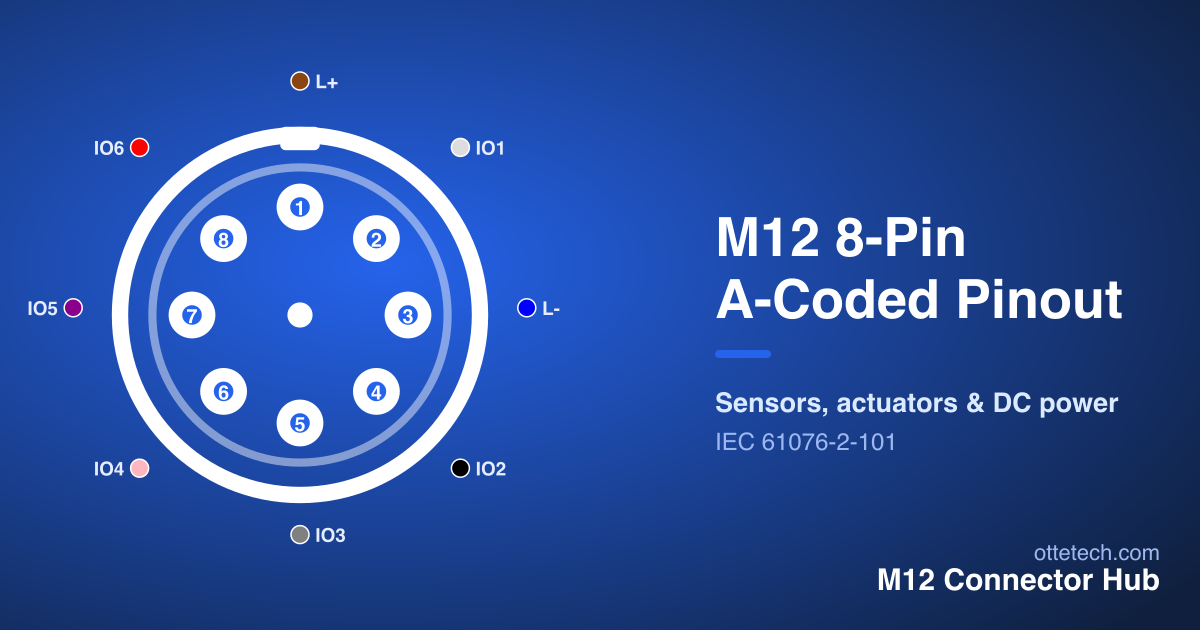
The diagram below shows the 8-pin A-coded layout. Hover a contact to highlight it in the table.
| Pin | Signal | Wire Color | Function |
|---|---|---|---|
| 1 | L+ | Brown | +24V DC |
| 2 | IO1 | White | I/O Channel 1 |
| 3 | L- | Blue | 0V / Ground |
| 4 | IO2 | Black | I/O Channel 2 |
| 5 | IO3 | Gray | I/O Channel 3 |
| 6 | IO4 | Pink | I/O Channel 4 |
| 7 | IO5 | Violet | I/O Channel 5 |
| 8 | IO6 | Red | I/O Channel 6 |
With eight contacts, the 8-pin A-coded connector provides several signal channels plus supply in a single coupling. As pin count rises, the individual contacts are smaller, so the current per contact is generally lower than on a 4-pin part — another reason to check the rating of the specific connector against your load. For how to read the layout, including the male/female mirror, see the M12 connector pinout guide or the interactive Pinout Viewer.
Wire Colors
8-pin A-coded connectors use a defined color sequence across their eight contacts. Because color conventions on higher-pin-count connectors can vary more than on the familiar 4-pin layout, the safest practice is to wire strictly to the pinout table for the exact connector you have, matching each conductor to its contact rather than relying on a remembered code. Verify continuity with a meter before energising, since a transposed contact on a dense connector is easy to make and hard to spot.
Use Cases
The 8-pin A-coded connector earns its place wherever a device needs more channels than a 4- or 5-pin layout can provide. Typical uses include multi-function sensors that output several values, encoders with extra signals, valve and actuator manifolds, and remote I/O points that consolidate multiple discrete signals into one cable run. By carrying several channels in one sealed, locking connector, it reduces the number of cable runs and connectors on a machine.
When even more density is required, the 12- and 17-pin A-coded connectors continue the pattern. At the other end, simpler devices use the 4-pin or 5-pin layouts. For the full picture of how pin counts map to applications, see the what is an M12 connector guide.
Wiring an 8-Pin Connector
Wiring a dense 8-pin connector demands more care than a 4-pin one simply because there are more contacts to get right. Always wire to the pinout table for the specific connector, coding and gender, matching each conductor to its contact one at a time. With eight contacts the male/female mirror is just as important as on smaller connectors — the layout flips between the plug and the socket — so confirm which face you are terminating before you start.
After termination, verify with a meter: check continuity to each contact and that there are no shorts between adjacent contacts, which are easier to create on a crowded insert. Keep in mind that higher contact counts mean smaller contacts and lower current per pin, so confirm the per-contact rating suits each channel's load rather than assuming a single connector-wide figure. Where possible, pre-moulded cordsets remove much of this termination risk. The installation guide covers the termination and torque steps that apply here too.
Higher Pin Counts: 12 and 17
When eight channels are not enough, the M12 A-coded family continues to 12 and 17 pins in the same 12 mm body. These maximise the number of signals a single connector can carry, which suits complex actuators, valve manifolds and multi-function devices that would otherwise need several cables. The trade-off is the same one that applies from 5 pins upward: as contacts multiply they shrink, so current per contact falls and wiring care matters more.
In practice, choose the smallest pin count that carries your signals comfortably — it keeps contacts larger, wiring simpler and parts more available. Step up to 12 or 17 pins only when the channel count genuinely requires it. For the full range of pin counts and how they map to applications, see the what is an M12 connector guide.
8-Pin A-Coded vs 8-Pin X-Coded
This is the key thing to get right with 8-pin connectors. The 8-pin A-coded connector carries signals and I/O; the 8-pin X-coded connector arranges its eight contacts as four shielded pairs for high-speed Ethernet up to 10 Gigabit. They have different keying and pinouts and cannot be mated together — the coding system keeps them apart by design.
So "8-pin M12" alone is ambiguous: it could be a signal connector or a 10GbE Ethernet connector. Always specify the coding. If you are wiring high-speed Ethernet rather than signals, you need X-coding — see the X-coded for 10GbE guide, and the M12 connector types guide for how all the codings compare.
Choosing an 8-Pin Connector
To choose an 8-pin connector, start from the role: signals and I/O point to A-coding, high-speed Ethernet points to X-coding. Then confirm the pin assignment against the device datasheet, check that the per-contact current rating suits your load, and settle the mechanics — gender, mounting and straight or angled body. To shortlist 8-pin parts by application, protocol and pin count, browse our 8-pin M12 connectors, use the connector selector, or send your requirements through the inquiry form.
One more consideration on dense connectors is cable management. Eight conductors make for a thicker, stiffer cable than a 4-pin lead, so allow a more generous bend radius and confirm the connector's gland accepts the cable diameter. On crowded panels, an angled body often routes an 8-pin cordset more cleanly than a straight one. Planning this in early avoids strained terminations that can work loose or break a contact over time.
Key Takeaways
- The 8-pin A-coded connector carries multiple signal channels (or signals plus power) in one coupling.
- Higher contact counts mean smaller contacts and lower current per pin — check the per-contact rating.
- 8-pin A-coded and 8-pin X-coded share a pin count but are different parts: signals vs 10GbE Ethernet.
- Wire to the pinout for the right coding and gender, and verify with a meter on the crowded insert.
- Step up to 12 or 17 pins only when channel count truly requires it; otherwise keep contacts larger.
Frequently asked questions
- What is the M12 8-pin connector used for?
- The 8-pin A-coded M12 connector provides multiple signal channels in one coupling, used for multi-function sensors, multi-channel I/O and devices that combine several signals with power. The 8-pin X-coded connector is a different part, used for high-speed Ethernet.
- How many signals can an 8-pin M12 carry?
- An 8-pin A-coded connector offers up to eight contacts for supply and multiple signals, so it can carry several I/O channels or a combination of power and signals in a single connection — more than the common 3-, 4- or 5-pin layouts.
- Is 8-pin A-coded the same as 8-pin X-coded?
- No. Both have eight contacts, but the A-coded version carries signals and I/O, while the X-coded version arranges the contacts as four shielded pairs for 10 Gigabit Ethernet. They have different keying and pinouts and cannot be mated together.
- What are the wire colors for an 8-pin M12 connector?
- 8-pin A-coded connectors use a defined color sequence for the eight contacts; because conventions can vary, always wire to the pinout table for the specific connector rather than assuming colors.
Looking for 8-Pin M12 connectors?
Browse our 8-Pin M12 range, or send us your requirements for a quote — including custom assemblies and samples.